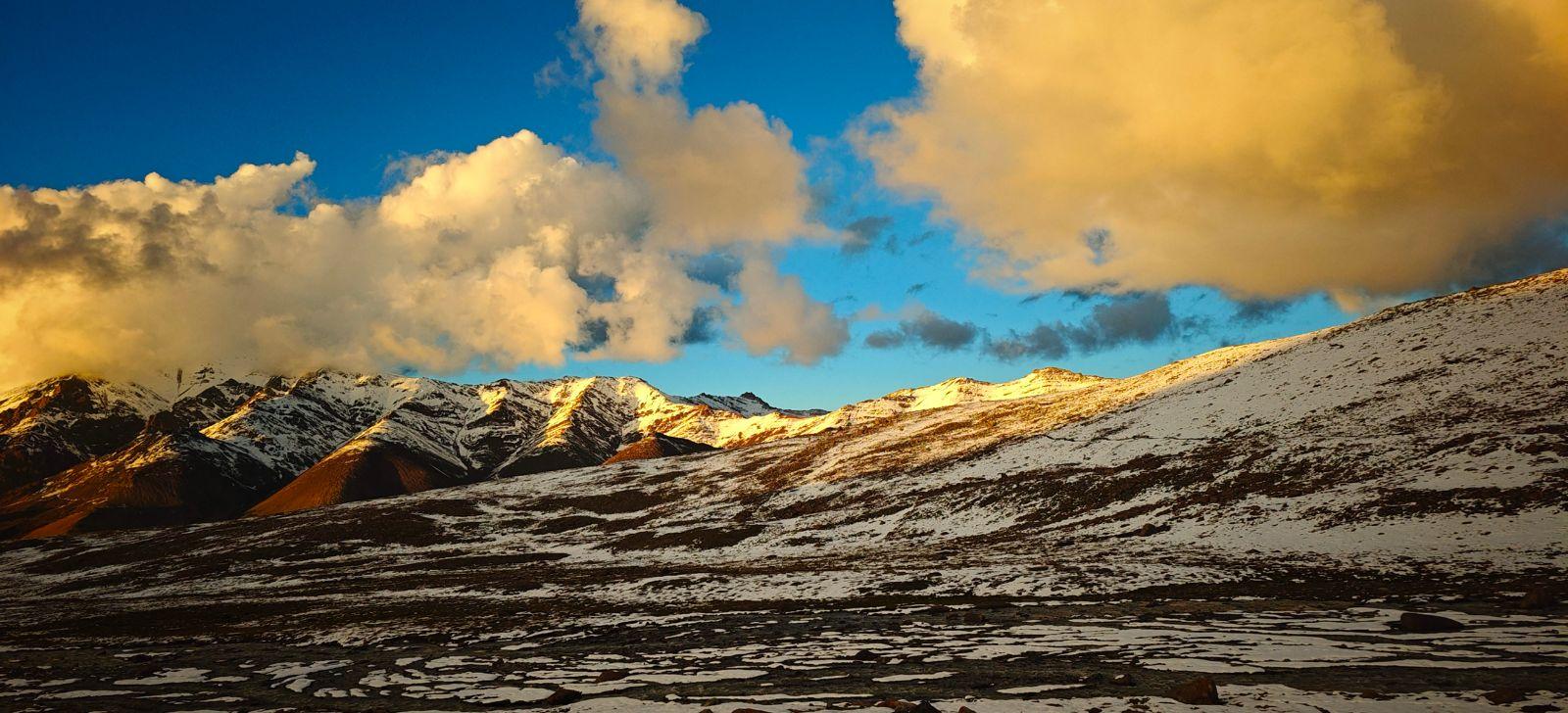
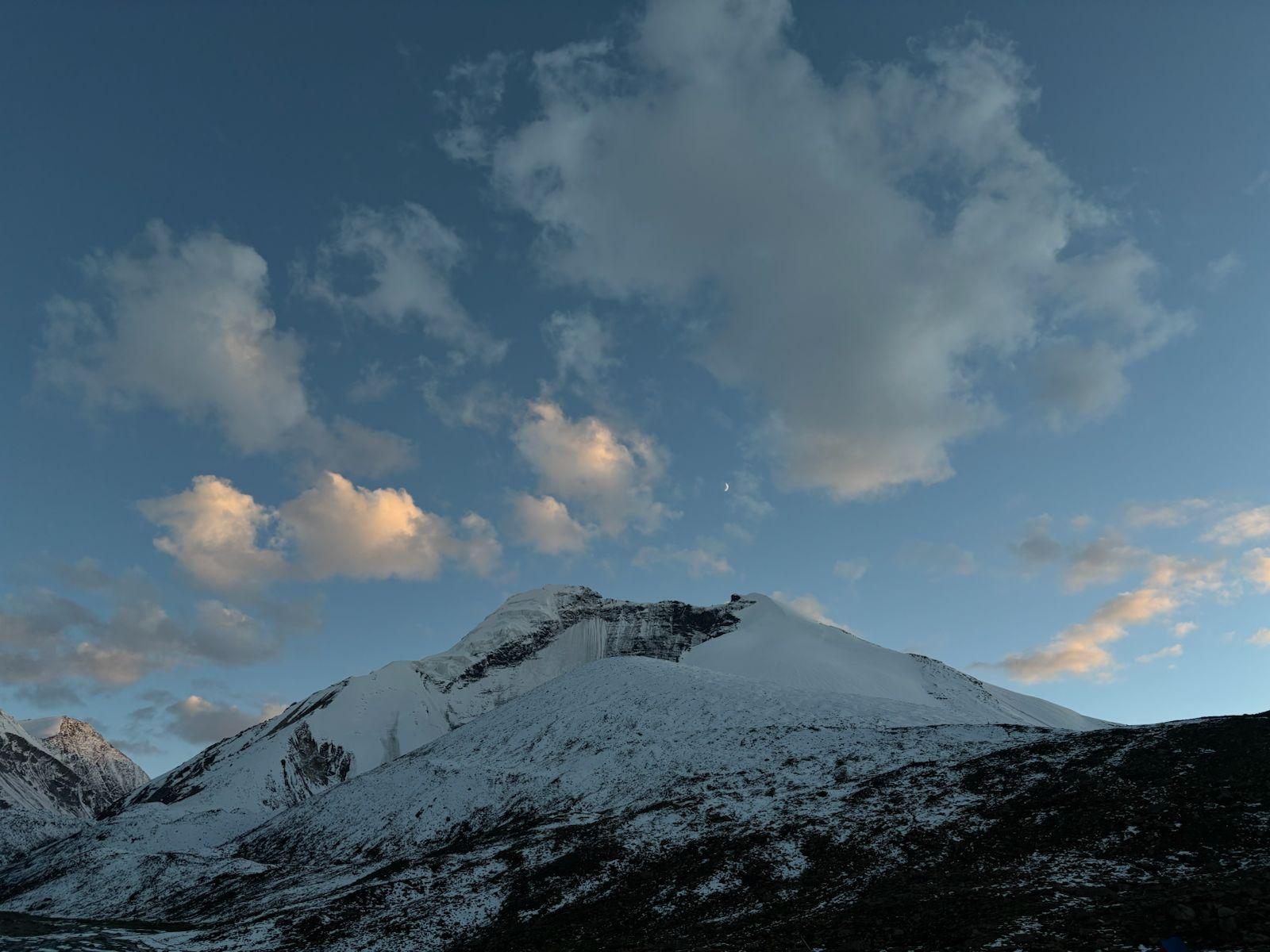
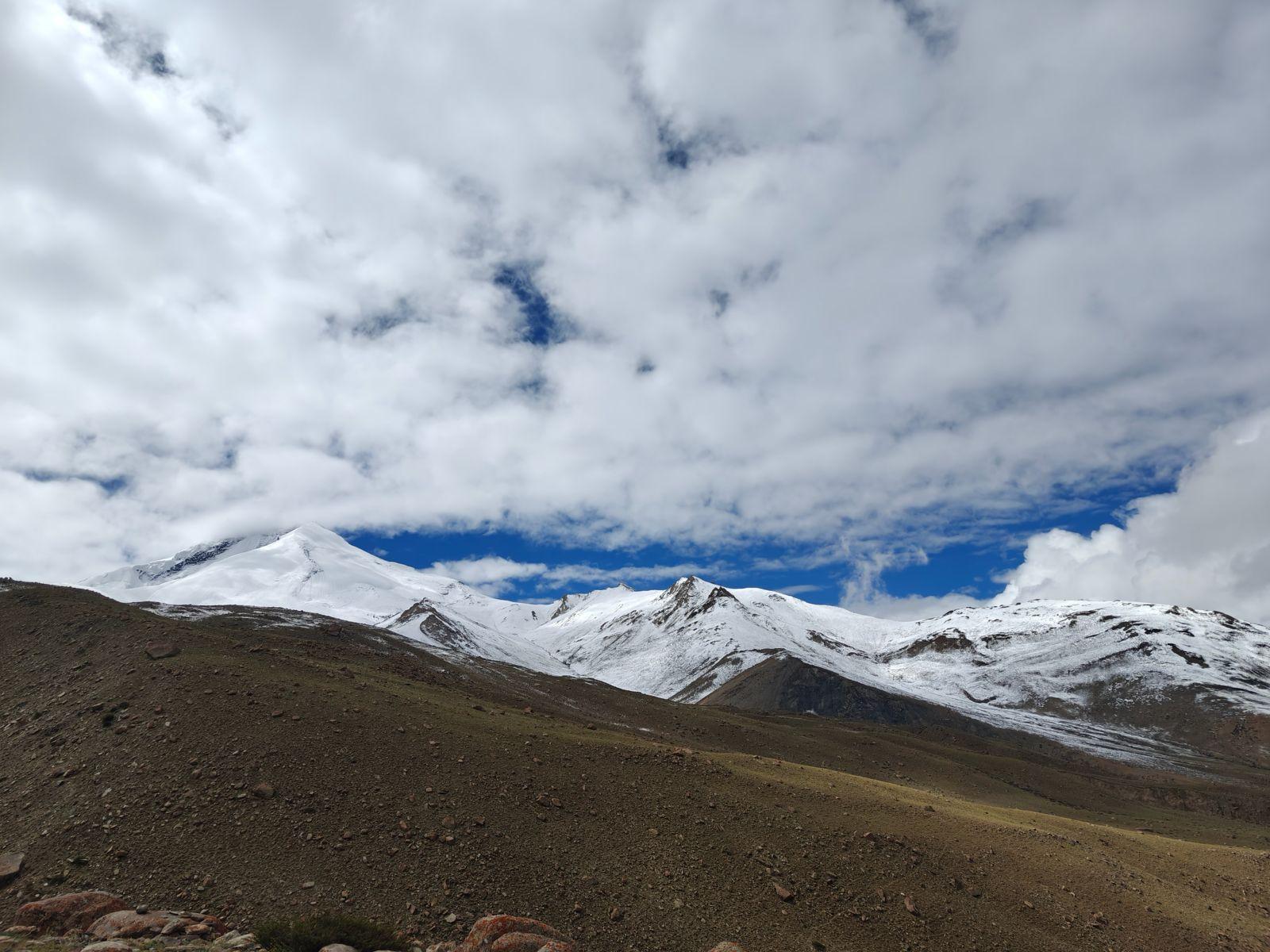


Kang Yatse I is one of those mountains that immediately tells you what it expects from you: honesty, preparation, patience, and respect.
At ~6,400 metres, it’s not a peak you “attempt”; it’s one you work your way into, layer by layer, until your body and mind finally settle into the rhythm the mountain demands.
The climb is real, with steep snow slopes, long summit pushes, load ferries, cold high camps, and the kind of altitude where every step feels heavy. But that’s also what makes it meaningful. Kang Yatse I is where trekkers become mountaineers. It teaches you efficiency, awareness, discipline, pacing, teamwork, and what it means to move deliberately through big mountain terrain.
And this is where Odyssey makes a difference. We keep our teams intentionally small so that you learn the craft, not just follow instructions. From how you pack your load for the ferry, to how you breathe on a 40° slope, to how you manage your layers at 5,800 metres, everything is taught, explained, and reinforced. It’s not a guided tour; it’s an apprenticeship in the mountains.
You don’t just climb with us.
You understand why you’re doing what you’re doing.The real test on Kang Yatse I isn’t brute strength.It’s your ability to show up consistently, even on tired legs.To stay calm when the altitude feels heavy.To trust the rope, the team, and the system.To keep moving, slowly and efficiently, long after the easy part is behind you.
This one is for trekkers who’ve done enough 4,000–5,000 m trails to know how their body behaves at altitude. For those who want to step into the world of mountaineering with the right learning, not shortcuts.
For people who enjoy the process as much as the summit, the load ferries, the drills, the early mornings, and the discipline.If you’re willing to train, listen, adapt, and work with the mountain rather than against it, Kang Yatse I is one of the most rewarding first 6000ers you can attempt.
Climb it with the right team, with the proper structure, and it changes the way you see big mountains forever.
Day 0
Arrive in Leh (Highly Recommended)
Elevation: 11,480 ft / 3,500 m
Stay: On your own (we will guide you to good options)
To ensure the expedition runs smoothly and safely, we strongly recommend arriving at least 48 hours before Day 1.
This buffer allows your body to acclimate to Ladakh’s altitude gradually and significantly reduces the risk of AMS as we move higher.
This is a full rest day. Walk around the market, hydrate well, and avoid overexertion or alcohol.
Day 0
Meet the Odyssey Team in Leh
Acclimatisation Walk + Traditional Ladakhi Dinner
Morning:
We meet the team informally today. Nothing official, just introductions and a slow acclimatisation walk to a nearby viewpoint (Shanti Stupa / Leh Palace trail / Tsemo).
This helps your body “switch on” to altitude movement without strain.
Evening:
We host you for a traditional Ladakhi dinner in a local family home, thukpa, skyu, butter tea, and fresh vegetables from their greenhouse.
It’s warm, grounding, and gives you a sense of Ladakhi hospitality before we begin the expedition rhythm.
Stay: On your own (we will suggest neighbourhoods and hotels)
Dinner: On us
Day 1
Official Expedition Briefing + Gear Check
This marks the formal beginning of the expedition.
We gather in the late afternoon for:
- Full route briefing
- Weather window discussion
- Load ferry structure
- Rope/ice axe/crampon handling
- Layering & packing system
- Safety systems (turnaround time, pace, hydration, red flags)
Then we go through every single item of your gear, checking the fit and compatibility, and filling any gaps from Leh’s gear shops.
The idea is simple:
Nobody leaves Leh underprepared.
Day 2
Leh → Chilling → Skiu (Drive + Trek)
Drive: Leh to Chilling (3 hrs)
Trek: Chilling to Skiu (~9–10 km)
Starting Elevation: 11,480 ft / 3,500 m
Ending Elevation: 11,150 ft / 3,400 m
We drive along the Indus and Zanskar rivers until the road ends at Chilling, a tiny settlement that feels like the edge of the known world.
Once we cross the bridge, the expedition finally begins on foot.
The walk to Skiu is gentle, easing you into Ladakh’s landscape: narrow gorges, sections carved out by the Zanskar, and silence broken only by the wind.
By late afternoon, we reach Skiu, with its poplar-lined lanes, old stone homes, and that distinct Ladakhi calm.
This is the first night we camp as a team.
Day 3
Skiu → Markha
Distance: ~16 km
Elevation: 11,150 ft / 3400m → 12,370 ft / 3,770 m
A long but gorgeous day.
This is classic Markha Valley terrain with wide-open sections where the river braids, deep canyon-like segments, and ancient chortens marking the way.
It’s a steady walk with minor undulations, nothing steep, but the distance makes the day feel full.
We cross several wooden bridges and small hamlet clusters.
Markha itself is one of the prettiest villages in all of Ladakh, with buckwheat fields, stone houses, a monastery above the settlement, and blue skies stretching endlessly.
Tonight, you’ll really feel the shift with the air, thinner, the mountains closer, and the expedition energy settling in.
Day 4
Markha → Thachungtse
Distance: ~ 12–14 km
Elevation: 12,370 ft / 3770 m→ 13,850 ft / 4,220 m
The terrain now changes.
The valley narrows, the trail climbs more steadily, and views of Kongmaru La and Kang Yatse II & I begin to appear at a distance.
This is also the day you’ll notice your breathing change, shortness, deeper breaths, and the need to pace steadily.
We pass Hankar village, then the last settlement before the high mountains truly begin.
Thachungtse is a quiet, open, windy, high-grazing meadow used by shepherds.
A perfect halfway point before the mountain reveals itself.
Day 5
Thachungtse → Kang Yatse Base Camp
Distance: ~6–7 km
Elevation: 13,850 ft / 4220 m → 15,750 ft / 4,800 m
This is one of the most exciting days.
As we climb to Base Camp, Kang Yatse I slowly rises into full view with a clean, elegant snow pyramid dominating the valley.
From here, everything revolves around altitude, discipline, and measured movement.
Base Camp is a wide moraine field with views of both summits (KY II & KY I).
We settle in, organise loads, and begin preparing for the expedition phase.
Tonight, the temperature drops sharply, welcoming you to life above 4,800 m.
Day 6
Acclimatisation at Base Camp + Technical Training
Elevation: 15,750 ft / 4,800 m
A crucial day.
We climb a few hundred metres to activate the body, practice crampon walking, ice axe use, rope systems, and load carrying techniques.
The idea is simple:
On a 6,000er, skills matter as much as fitness.
The afternoon is for resting, hydrating, and an early dinner.
Summit teams learn to switch to “expedition mode” with efficiency, routine, and discipline.
Day 7
Base Camp → Advance Base Camp (Load Ferry) → Return
Elevation: Base Camp 15,700 ft / 4,800 m → ABC 17,060 ft / 5,200 m
This is your first real test.
Carrying a load at altitude teaches you more about yourself than any gym session ever will.
The trail is steep, winding through moraine and loose rock.
Above 5,000 m, everything slows down; even tying your shoelaces feels like a task.
We drop our loads at ABC, take a short break, and descend to Base Camp.
This rotation is what allows proper acclimatisation.
Day 8
Base Camp → ABC (Shift Camp)
Elevation: 15,700 ft / 4,800 m → 17,060 ft / 5,200 m
We pack up our personal gear and move to Advance Base Camp.
ABC is minimal with just the team, the mountain, and silence.
Nights are colder, winds are stronger, and the summit wall feels close enough to touch.
Dinner is early.
We check gear, pack summit packs, confirm weather conditions, and sleep as early as possible.
Day 9
Summit Attempt (6,400 m) → Back to Base Camp
Summit camp ~ 18,700 ft / 5,700 m
Summit: 20,955 ft / 6,387 m
Return to Base Camp: 15,750 ft / 4,800 m
This is the big day, long, slow, mentally heavy, and advantageous.
The approach
We climb the snow dome in roped teams.
The gradient is steady but constant, with no flat breaks or manageable sections.
This is where your months of training finally matter.
The final shoulder
Just before the summit push, the angle increases.
Ice axe work gets real.
Breathing is loud, slow, and deliberate.
The summit
Kang Yatse I offers one of the best summit views in Ladakh:
- K2 side of the Karakoram
- Stok range
- Zanskar ranges
- Tibetan plateau light
- And Kang Yatse II rising beside you
We don’t stay long as the winds are unpredictable at 6,300+ m.
The descent
This is the hardest part of the entire expedition.
It’s long, draining, and demands full attention.
We return to ABC, regroup briefly, then descend all the way to Base Camp to sleep low.
Day 10
Base Camp → Chokdo via Kongmaru La → Leh
Distance: ~ 16–18 km
Elevation: 15,700 ft / 4,800 m → Cross Kongmaru La 17,320 ft / 5,280 m → 12,795 ft / 3,900 m
Kongmaru La is a spectacular exit with red rock canyons, deep gorges, and wild Ladakhi landscapes.
After days of snow and ice, the desert warmth feels like another world entirely.
From Chokdo, we drive back to Leh and check in.
Showers, hot food, and absolute beds feel unreal after the expedition.
Our Expectations from Participants
Climbing Kang Yatse I is not a “tough trek.” It is a full-scale 6,000-metre mountaineering expedition with load ferries, technical sections, glacier travel, and long summit hours at extreme altitude.
We take your safety seriously, and we expect you to take your preparation just as seriously.
Here’s what we expect from every participant:
1. Arrive prepared: physically, mentally, and with intent.
This climb demands more than general fitness.
You should already be:
- Comfortable with long days (6–8 hours) on steep terrain
- Able to carry 10–12 kg at altitude during load ferries
- Noticing how your body responds above 4,000–5,000 m
- Aware that some days will feel slow, heavy, and uncomfortable
A 6,000er pushes your mind far more than your legs.
2. Be willing to train consistently for 2-3 months.
Once you register, we give you a structured training plan and add you to a training group.
But it only works if you show up for yourself.
Your summit window depends on your preparation.
So does the safety of the entire rope team.
3. Respect the expedition rhythm.
Mountaineering has its own discipline:
- Early nights, early mornings
- Hydration and nutrition, even when you don’t feel like it
- Listening to your guide and rope leader
- Moving efficiently, not fast
- Accepting that sometimes the weather decides for us
We expect you to embrace the routine, not resist it.
4. Be a good rope-team member.
On summit day, your behaviour affects everyone tied to the rope.
We expect you to:
- Maintain a steady pace
- Communicate honestly
- Keep your gear ready and organised
- Follow safety instructions instantly
- Hold your line, especially during steeper or exposed sections
A rope team works only when everyone shows up as a professional.
5. Trust the process, and stay adaptable.
Altitude, weather, and mountain conditions can change plans overnight.
You may:
- Repeat acclimatisation hikes
- Wait out weather windows
- Shift summit day
- Turn around if safety dictates
We expect you to trust the expedition leader’s calls without negotiation.
These decisions are made for your safety.
6. Respect the people and the mountains.
From the local staff to the high-altitude porters, this mountain runs on teamwork.
We expect:
- Courtesy
- Patience
- Leaving No Trace
- No shortcuts
- Genuine respect for local culture
7. Come with the right spirit.
This is not a luxury trip.
This is not a “show up and get carried to the summit” expedition.
It’s hard work.
It’s long days.
It’s cold mornings, heavy boots, slow breaths, and honest effort.
If that excites you, you belong on this expedition.
Minimum Fitness Required
Climbing Kang Yatse I requires a different level of preparation than trekking.
Here’s the fitness benchmark you should meet before arriving in Leh.
1. Aerobic Endurance
You should be able to perform comfortably:
- An easy-paced run for 90-120 minutes or
- 10 km brisk walk in under 100 minutes or
- Stair climb: 1,000–1,200 stairs in 30–35 minutes
This tells us your engine is ready for sustained exertion at altitude.
2. Strength & Load Carrying
You must be capable of:
- Carrying 10–12 kg for 3–4 hours
- (simulating load-ferry days)
- Performing leg strength movements like squats, lunges, step-ups (3–4 sets of 15–20 reps)
- Holding a plank for at least 90 seconds
Summit day requires strong legs and a stable core so your form doesn’t collapse on snow slopes.
3. Altitude Response
Though we cannot test this beforehand, you should have:
- Prior experience above 4,500 m, OR
- Strong multi-day trekking background (5–7 day treks)
This expedition is not suitable for first-time trekkers.
4. Mobility & Balance
You must have basic agility for:
- Moving on moraine
- Snow slopes
- Rock sections
- Knife-edge ridges
- Walking in mountaineering boots & crampons
We don’t need elite athletes; we just need people who can move well.
5. Mental Preparedness
This is half the expedition.
You should be comfortable with:
- Slow, deliberate movement
- High-altitude discomfort
- Very early starts (midnight/1 am on summit day)
- Freezing temperatures
- Turn-around decisions if safety demands
Your mental resilience is just as crucial as your VO2 max
Training Plan (Sample)
This is a sample training plan. Once you register, we provide a detailed personalised plan and add you to our closed WhatsApp training group, where we monitor progress every 15 days.
Weeks 1–4: Foundation
- 3–4 aerobic sessions per week
- 2 strength and mobility sessions
- 1 long hike/walk with a 6–8 kg pack
Weeks 5–8: Build Phase
- 4 aerobic sessions (longer zones 2–3)
- 2–3 strength sessions
- 1 long hike with an 8–10 kg pack
Weeks 9–12: Peak Phase
- Simulate load ferry days.
- 10–12 kg pack hikes
- Stair climbing
- Snow-walking practice (if possible)
Inclusion
Exclusion
Is Kang Yatse I suitable for first-timers?
Kang Yatse I is a whole mountaineering expedition with load ferries, technical sections, snow slopes, and a long summit push above 6,300m. You must have prior high-altitude trekking experience (preferably above 4,500–5,000 m) and a consistent training routine.
If you are new to the mountains but want to build towards a 6,000er, begin with:
Pangarchulla
Kang Yatse II
Black Peak Prep Treks
Any 5–7 day Himalayan trek
What makes Kang Yatse I different from regular treks?
You will:
Rope up
Carry load on ferry days
Use crampons, an ice axe, and a harness
Move through moraine & snow slopes
Follow turnaround times and summit protocols
It’s an entirely different rhythm and discipline.
How technical is the climb?
Meaning:
Steep snow slopes (30–45°)
Short exposed sections
Glacier/moraine navigation
Use of ice axe & crampons
Fixed rope sections depending on conditions
Our guides will decide rope-fixing requirements based on the season’s snow conditions.
How long is summit day?
What if I cannot summit?
What is the accommodation like?
This is NOT a luxury trip; it’s functional, safe, warm, and expedition-style. However, we provide the best facilities throughout the trek.
What kind of food is provided?
Soups, dal, rice, and vegetables
Pasta, khichdi, roti, porridge
Eggs (where possible)
Hot drinks morning & evening
Summit-day snacks (gels, bars, hydration)
We can accommodate vegetarian, vegan, and gluten-free requirements with prior notice. All the meals are planned with nutrition, hiking hours, and hygiene in mind.
What equipment will Odyssey provide?
Double mountaineering boots
Crampons
Helmet
Ice axe
Harness
Ropes
Carabiners & technical hardware
You bring your personal clothing & accessories, and we provide a complete packing list.
How cold does it get?
Is there a network or electricity?
Markha: Patchy
Above Markha: No network
Base Camp & above: Zero connectivity
Charging options are minimal.
Carry a 20,000–30,000 mAh powerbank.
Do I need insurance?
You must have insurance that covers:
6,000 m altitude
HAPE/HACE
Helicopter evacuation
Medical emergencies
Note: You will NOT be allowed to join without valid insurance.
How will altitude be handled?
Early arrival + 2–3 days acclimatisation
Acclimatisation hikes
“Climb high, sleep low” rotations
Daily health checks (pulse ox, symptoms monitoring)
Guides carry AMS medication for emergency use.
Can we rent gear in Leh?
How big are the teams?
Why climb Kang Yatse I with Odyssey?
Quality of guidance
Strong safety systems
Small-team efficiency
Skill-building, not just summiting
Honest decisions in the mountains
Learning alpine systems, not being dragged to the summit
You will come home a better climber, not just a summit photo.
SELECT DATE TO REGISTER
More Trails To Chase
Thank You!
Your form has been submitted successfully. We'll get back to you soon.
₹94,000 + 5% GST
