 Vivek Saini
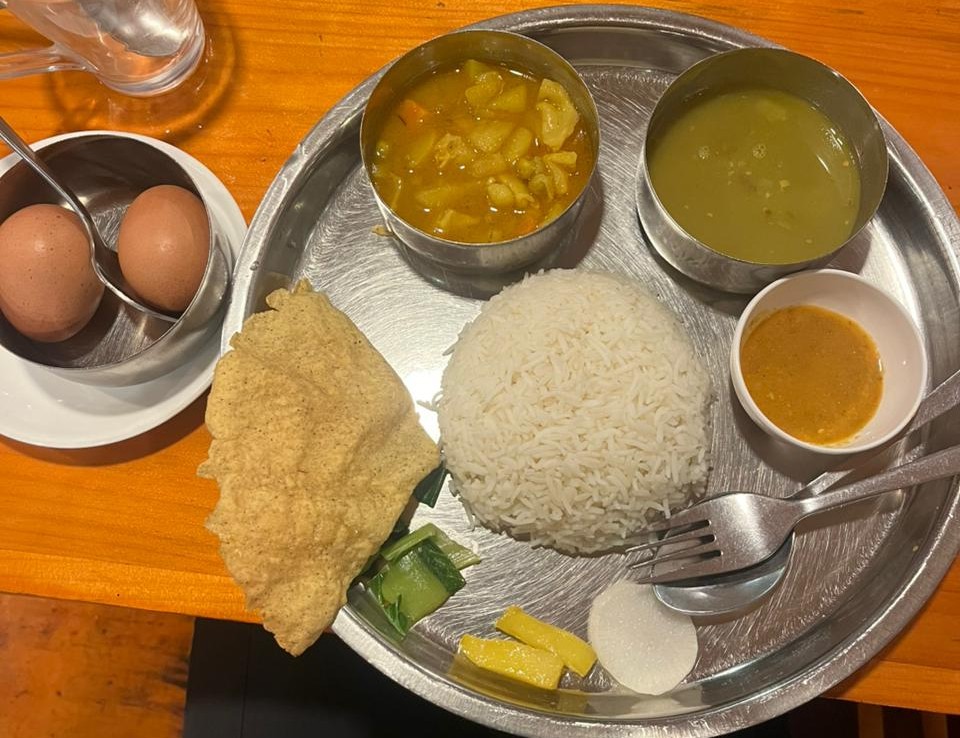

A typical Dal-Bhat lunch in the tea house
If you’ve trekked in India before, you’re probably used to seeing “all meals included” in every itinerary.
But when you look at our Everest Base Camp or Manaslu Circuit treks, you’ll notice something different: meals aren’t part of the trek fee.
It’s not an oversight.
It’s a conscious choice, one that makes your Nepal experience more flexible, more authentic, and often, more affordable.
Here’s why:
1. Because including meals makes the trek unnecessarily expensive.
If we add meals to the trek cost, the overall price goes up significantly.
And that’s not even the real problem; it also forces us to standardise the food for the entire group.
That means everyone would have to eat the same pre-decided meals, even when sitting in a cosy tea house with a full menu in front of them, pancakes, soups, noodles, pizzas, or the humble dal bhat.
We don’t want to restrict your experience in that way.
When you trek with Odyssey in Nepal, you get the freedom to choose what you eat and where you eat it
2. Because every tea house has its own story and menu.
One of the most beautiful parts of trekking in Nepal is the tea house culture.
Every lodge is family-run, every kitchen has its own flavour, and every meal is cooked fresh to order.
By ordering your own food, you directly support the families who run these tea houses.
You see exactly where your money goes, with no middle layer and no bulk billing.
That plate of dal bhat or cup of ginger lemon tea you buy helps sustain the local economy of the very valley you’re walking through.

The options at 15,000 feet will spoil you, for good!
3. Because flexibility matters, especially at high altitude.
In the mountains, your appetite changes every day.
Some mornings, you’ll wake up craving a pancake and coffee; other times, you’ll want a light soup or porridge.
At higher altitudes, even digestion behaves differently, so being able to listen to your body and order what feels right is a small yet powerful way to take care of yourself.
It’s also part of the larger philosophy we believe in: learning to be self-aware and self-sufficient in the outdoors.
4. Because prices vary as you go higher.
A meal that costs 700 NPR in Namche might cost 1,500–2,000 NPR in Lobuche, and for good reason.
Everything you eat up there has been carried on the back of a porter or a yak.
Standardising that variation for a group would mean overcharging some trekkers or underpaying tea house owners.
We prefer transparency; you pay only for what you eat.
To get a sense of the options, browse through the photos below. These are actual tea house menus from our recent teams in Nepal.


Note: As you ascend towards Gokyo, Lobuche, or Samagaon, expect prices to rise slightly, as porters or yaks carry up every ingredient.
5. What should you budget for food in Nepal?
While the variety and pricing differ from village to village, here’s a general idea of what you’ll spend each day on the trail:
Breakfast: 600–800 NPR
(porridge, eggs, toast, or pancakes with tea or coffee)
Lunch: 800–1,000 NPR
(fried rice, noodles, thukpa, or dal bhat)
Dinner: 1,000–1,200 NPR
Dal bhat is always the best choice, freshly cooked, unlimited, and warm)
Extras: 300–500 NPR
(for tea, coffee, Wi-Fi, or snacks along the way)
On average, budget around ₹2,000-₹2,500 (3,000-4,000 NPR) per day for meals, drinks, and small comforts.
And if you prefer an all-inclusive plan, tell us.
We know that some trekkers prefer the convenience of having everything covered in advance.
If that’s what you’d like, just let us know, we’ll price the trek accordingly and handle your meals throughout.
In the end
We don’t exclude meals to make things more complicated.
We do it because we want you to experience Nepal the way it’s meant to be, open, connected, and full of small choices that make your journey your own.
In these mountains, even something as simple as what you eat is part of the adventure.
