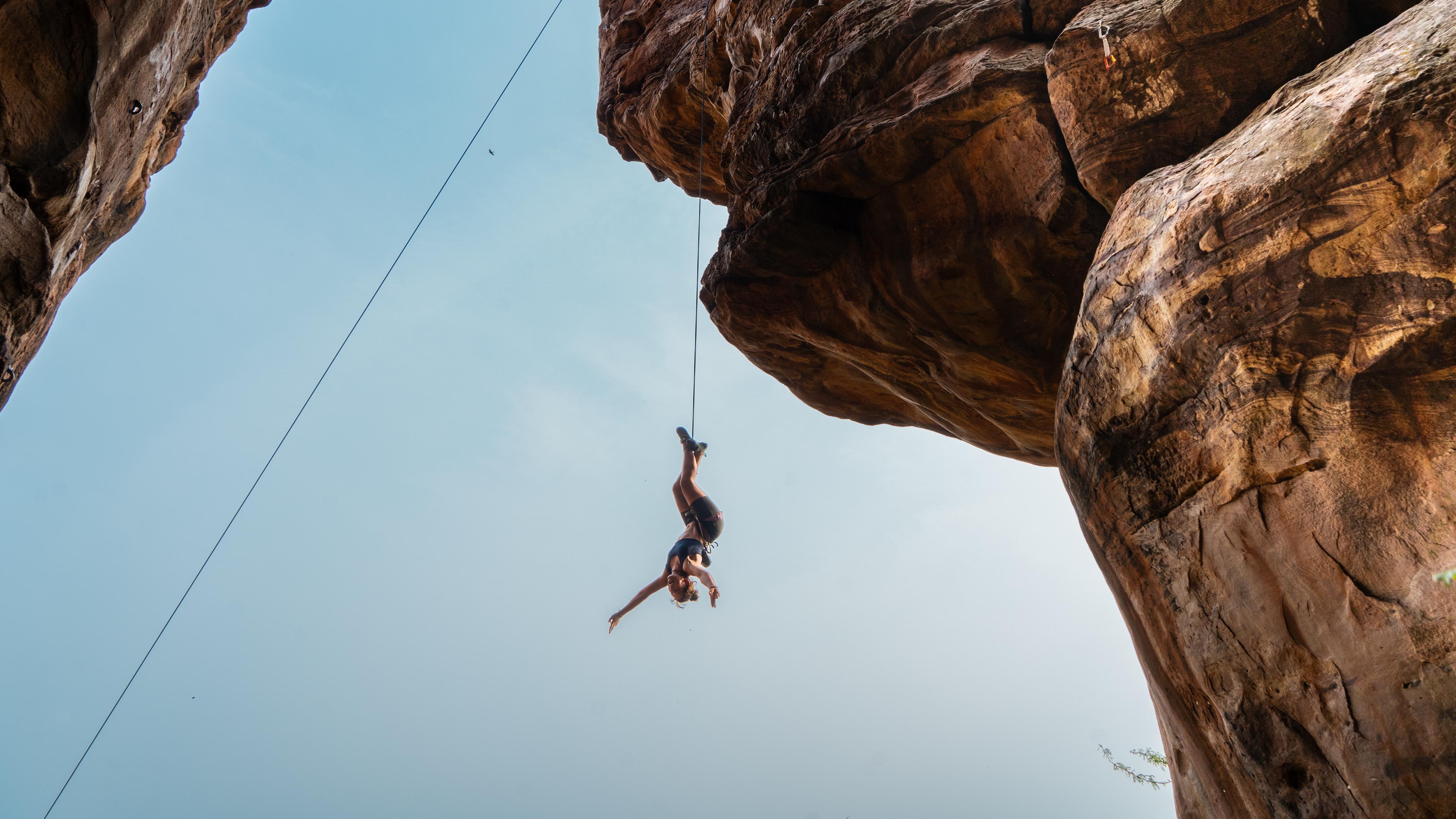
Some climbing courses teach you a skill. This one hands you a house, a crag, and eight days with people who'd rather be climbing than doing almost anything else.
We're not running a bootcamp. We're running a season in Badami, sandstone walls a short walk from where we're staying, a shared house with our own cooks, and mornings that start with someone making coffee at the crag before the first person's even tied in. Sessions run through the day, chalk dust and sunscreen and the same five songs someone keeps replaying. By evening, ropes get coiled, someone's cooking or someone's not, and the night usually ends with a movie projected on a wall, everyone half-asleep on the same mattress pile, talking about tomorrow's climb.
Everyone ropes up together, climbers who've never touched rock, and a few who've been at this for years, all figuring out the same sandstone. You'll go from tying your first figure-8 to reading grades, trusting your feet on a rock that doesn't always trust you back, and, if you're ready for it, clipping into your first lead climb. There's a full day on the boulders, a day where the curious ones get hands-on with anchors and real gear, and a closing assessment that earns you an actual top-rope certification, not just a photo to post.
If eight days is more than you can spare, we run weekend batches too, same crag, same house, the same coffee at the same rocks. On the weekend programs, you get a taste of what the full eight days are about.
Day 1
Getting Oriented
We start at the crag with Gear handling, harnesses, helmets, belay devices, and the knots that hold the whole sport together, figure-8 follow-through, stopper knot, clove hitch.
By the end of the first session you're tied in and on your first top-rope climb, on the easiest routes Badami has to offer. This is also where the group actually becomes a team and introductions happen on the rock.
Day 2
Building the Basics
This is where belaying gets taken seriously, PBUS, brake-hand discipline, the difference between holding a rope and actually being someone's safety system. Alongside that, we work on movement: footwork, balance, weight shifts, and what climbing grades actually mean once you're the one deciding whether a route looks "doable."
You'll be climbing longer, slightly harder top-rope routes by the end of this stretch.
Day 3
A Day on the Boulders
No ropes, no harnesses, learning to move with the rocks. A full day given over to bouldering: balance, spotting, crash-pad placement, and the kind of low-consequence problem-solving that makes you a better climber everywhere else. It's also usually the day people laugh the most.
Day 4
Anchors and a Taste of Lead
For anyone curious about what's happening above their head when they're on a route, this is the day. We go hands-on with how anchors actually work, handle real passive and active gear, and for those ready for it, get a taste of lead climbing through mock clipping.
Beginners are welcome to watch and learn conceptually; if you've climbed before and want to go deeper, this is where you get your hands dirty.
Day 5-6
Pushing Grades and Learning to Descend
Back to top-rope, now at harder grades, building on everything so far. This stretch also covers rappelling, learning to descend a route confidently and safely, which turns out to be a skill people underestimate until they need it.
Day 7
Assessment and Certification
The final stretch is where it comes together: a belay proficiency check, a knot test, cleaning a top-rope setup, and a closing climb that puts everything to use. Pass it, and you walk away with an actual top-rope certification, not a participation certificate. We close with the last dinner of the season together, with the team that got you here.
Bonus
The Weekend Program
Two days, same crag, same house, an introduction rather than a compressed version of the 8-day course.
Day One covers the fundamentals: gear, knots, harness and belay device basics, and your first top-rope climbs. By the end of the day you'll have belayed and been belayed, and climbed routes you wouldn't have touched 24 hours earlier.
Day Two builds on that with more top-rope climbing at a slightly higher grade, plus a taste of bouldering/rappelling enough to leave you with a real sense of what climbing outdoors actually feels like, not just a survey of terminology.
Who is this program for?
No prior climbing experience is required, the course is built to take you from zero. If you've climbed before, you're just as welcome; most batches end up being a mix of both.
That said, come prepared for real physical activity across full days: walking to and from the crag, climbing repeatedly through the day, and being on your feet for hours. Reasonable fitness helps you enjoy it more, not less, this isn't a test of strength, but stamina and grip endurance both get worked hard, especially by the boulder day.
A note on the optional anchors-and-lead day: it's there for anyone who wants to go deeper, but it's not mandatory, and beginners can sit it out or just observe without it affecting anything else in the course.
Heights are, obviously, part of the deal. Most people find the fear fades faster than expected once they're actually on the wall with a belayer they trust, but if you know heights are a genuine issue for you, it's worth being honest with yourself before signing up.
Flag any medical conditions to us before the course, particularly anything affecting joints, grip strength, heart conditions, or recent injuries, so we can plan around it rather than find out at the crag.
Inclusion
Exclusion
SELECT DATE TO REGISTER
Thank You!
Your form has been submitted successfully. We'll get back to you soon.
₹ 23,799 + 5% GST
