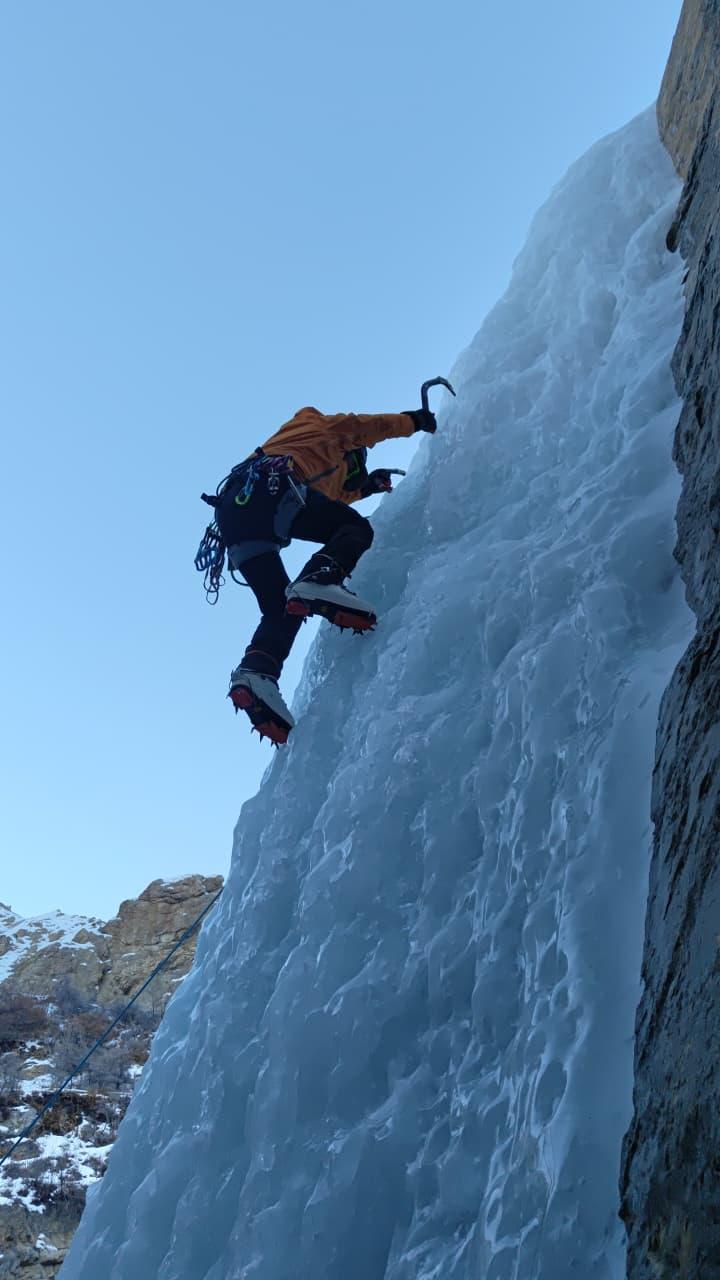
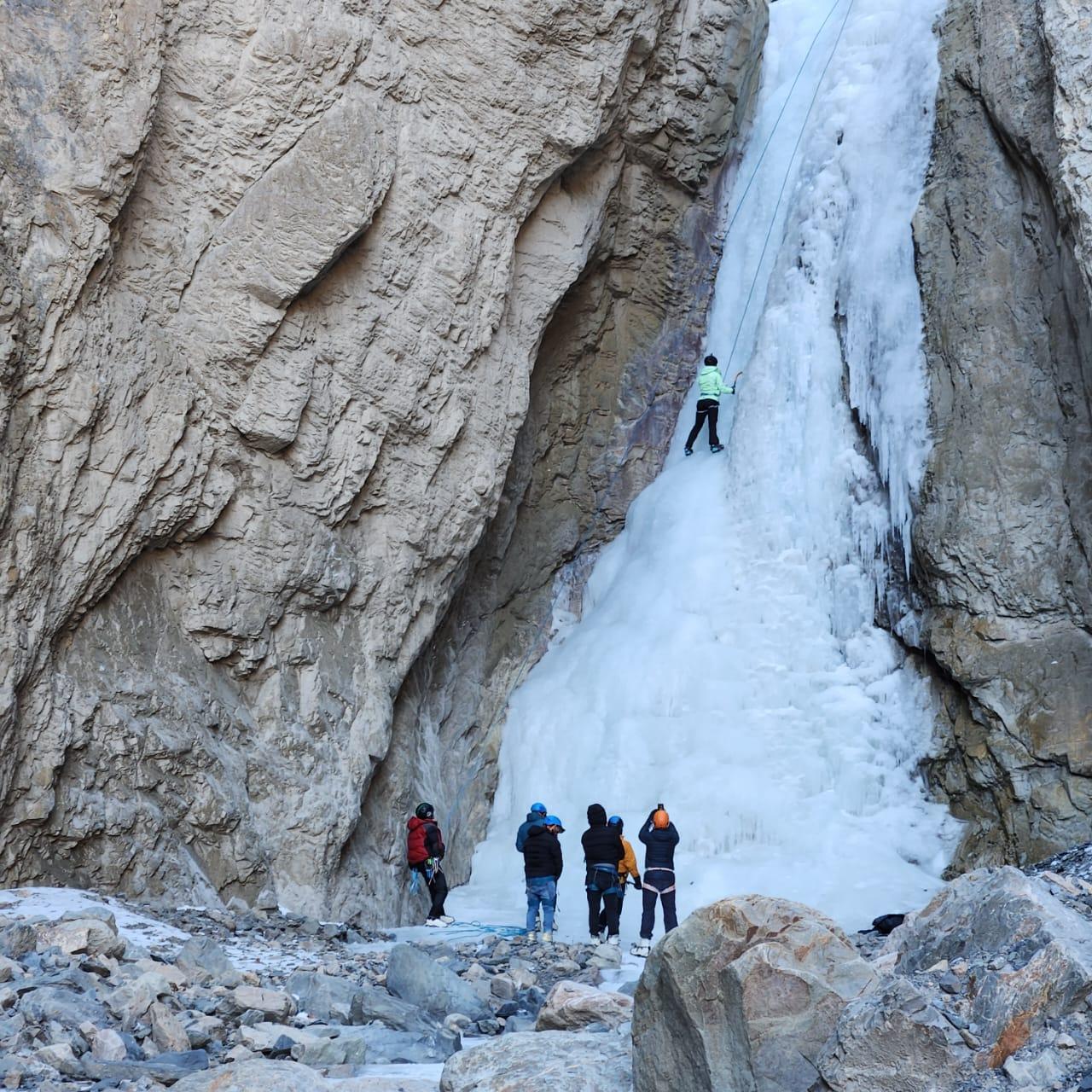
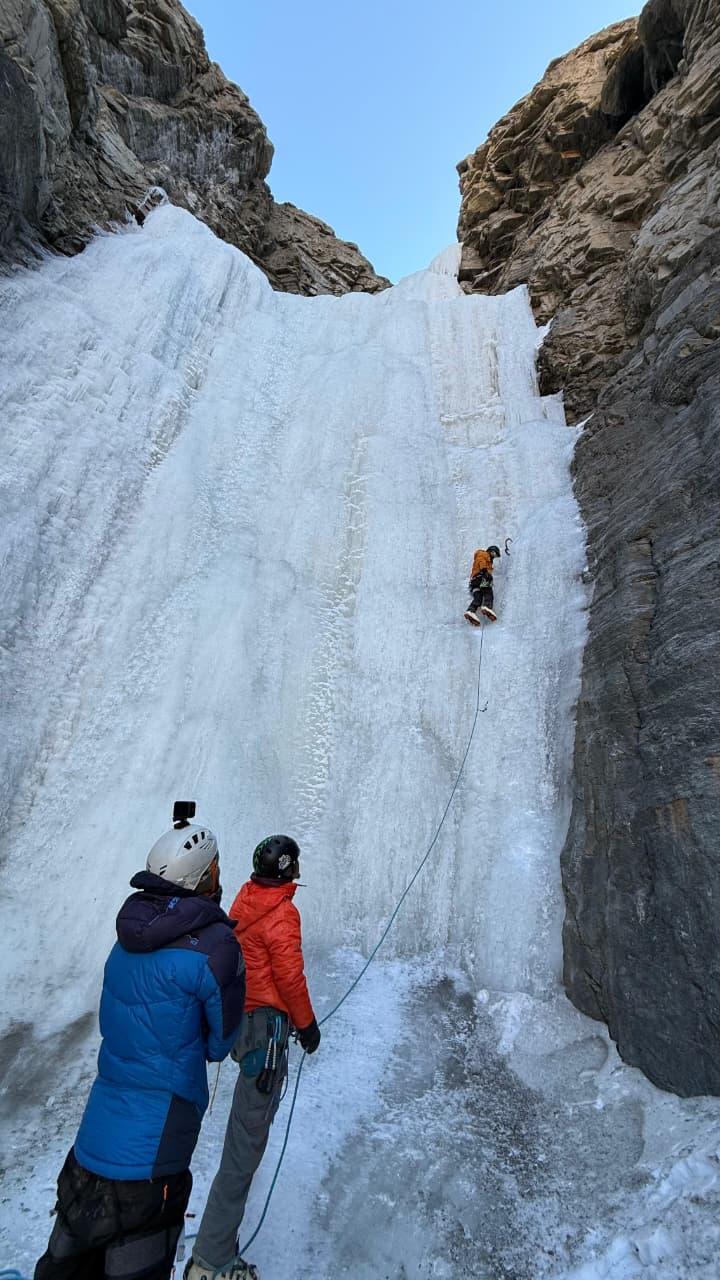


Ice climbing is a technical skill, and you learn it fastest on the ice. Most of what you need to start fits into a single day. The rest of the week is for climbing, and that’s how this workshop is built.
The first two days get you to Spiti and ready. Day 1 is the drive from Shimla to Kalpa - the drive is broken into two separate legs to help you acclimatise better. On Day 2, you travel on to the base village in the morning, then spend the afternoon acclimatising and getting familiar with your equipment. Day 3 is the fundamentals day: moving in crampons, using the ice axe, belaying and understanding anchors. From Day 4, you climb. Days 4 to 7 are spent on the crag, working through moderate lines first and steeper lines as your technique settles.
On Day 6, once you’ve spent enough time on the ice to understand how it behaves, you learn to build a V-thread. You make one, test it, and then climb with it as part of the rope system, under supervision.
Frozen waterfalls change with the temperature. Instructors check the ice every morning, and the plan adjusts to what the ice allows. The rest day on January 30th also works as a buffer for weather or ice conditions.
By the end of the workshop, you’ll be able to gear up on your own, move confidently on ice in crampons, climb easy top-rope routes, belay a partner, and build and test a V-thread.
This is a foundation workshop. All climbing is on a top rope. It doesn’t cover lead climbing or placing screws as a leader.
Day 1
Shimla to Kalpa
A road day. The drive from Shimla takes you into Kinnaur and up to Kalpa, a village that overlooks the Kinner Kailash range. We arrive in the early evening and settle in.
- Evening briefing: a walk through the week, what ice climbing asks of you, and what each day involves.
- Gear check: instructors go through your clothing, boots and layering, so any gaps are fixed before Spiti.
Day 2
Kalpa to Spiti – Acclimatise and Meet Your Gear
The first half of the day is on the road to the base village in Spiti. We arrive in the afternoon and spend the rest of the day easing into the altitude and getting to know the equipment.
- Afternoon: a gentle walk around the village to help your body adjust to the altitude.
- Gear introduction: helmet, harness, crampons, ice axes, screws, ropes and carabiners. Instructors fit your boots, crampons and harness, and you practise putting crampons on and taking them off.
- Evening: basic knots (figure-eight follow-through, clove hitch and stopper) and a short talk on reading ice and what Day 3 looks like.
Day 3
Fundamentals Day at the crag
The one-day is built entirely around fundamentals. You start on gentle ice and end the day climbing a low-angle top rope, with a partner belaying you.
- Morning, movement: crampon footwork on low-angle ice (flat-footing, duck walking and front-pointing), going up, down and across. You also practise falling safely and recovering your balance.
- Midday, the ice axe: grips, swing, placement and removal. Self-arrest on a safe runout, and three-point movement on a gentle pitch.
- Afternoon, belaying: belay setup, brake hand and commands, taught on the ground first. Then your first top-rope climb on low-angle ice.
- Anchors: learn to build different types of anchors, under instructor supervision.
Anyone who needs more time on movement keeps working on it and joins the next session when ready.
Day 4
Climbing Day One – Mileage on Vertical Ice
The first full day on the crag where we climb. A short refresher in the morning, then top-rope laps on a moderate line, with feedback from the instructors after each climb on your footwork and axe economy. In the afternoon, you move onto a steeper line and practise resting positions, pacing and breathing on ice. Everyone climbs and belays in turn.
Day 5
Climbing Day Two - Focus on Efficiency
The same moves with less effort. Each lap has a specific focus: straight-arm hanging, efficient kicking, and reading the ice to choose your placements. In the afternoon, you climb varied lines with different ice character (brittle, plastic and aerated) and learn to adjust your swing and footwork to each. Short partner debriefs after every climb.
Day 6
Climbing Day Three - Meta Skills of Ice Climbing
The advanced module. In the morning, you learn how a V-thread works and where to place one, then build one, thread it and test it, with instructors supervising each step. At midday, you climb with a V-thread as part of the rope setup and discuss when to use one and where its limits are. The afternoon is for top-rope laps on the steepest line the group is ready for.
Day 7
Climbing Day Four - Stitching it all together
The last day on the ice. You choose the lines, and the instructors watch and coach. The afternoon stays flexible: four days on the ice is tiring, and nobody has to take every lap. We end with a closing circle on what you learned, what to work on, and where to go next.
Day 8
Rest Day
A day off. Sleep, eat and let your forearms and calves recover. If weather or ice conditions cost us a climbing session earlier in the week, this day is used as the buffer.
Day 9
Spiti to Shimla
The drive back to Shimla via Kinnaur. The workshop ends on arrival to Shimla. Make sure you keep 1 Day of buffer while you are booking tickets from Shimla to your respective cities.
Prerequisites
Experience: None required. If you’ve walked on snow or used crampons before, it helps, but we start from the basics.
Fitness: You need to be comfortable on your feet for a full day outdoors in the cold, and able to walk uphill on snow. A consistent routine of aerobic, strength (especially upper body, grip and core) and mobility training will make the week far more enjoyable. Unsure where to start? Talk to us.
Altitude: Spiti is at high altitude. Day 2 is built to help you acclimatise, but you should know the signs of altitude sickness and tell your instructor early if you feel unwell.
Health: Tell us about any medical condition, recent injury or medication before the workshop. It helps the instructors plan for you.
Mindset: Be willing to be cold, tired and a beginner for a few days. Ice climbing rewards patience.
Personal gear to bring
Feet: Warm wool socks, with spares. Mountaineering boots are available on rent (see below).
Hands: Thin liner gloves, warm climbing gloves, and a spare pair.
Body: Thermal base layers, a fleece or mid-layer, a down jacket for belaying, and a waterproof shell jacket and trousers.
Head: Warm cap, balaclava or buff, sunglasses and snow goggles.
Other: Headlamp with spare batteries, insulated water bottle, sunscreen, lip balm and a small daypack.
Inclusion
Exclusion
Do I need any ice climbing experience?
Is this workshop only for beginners?
Will I lead climb?
Do I need to bring my own technical gear?
What about boots?
How cold will it be?
What if the ice isn’t in good condition?
How do you handle the altitude?
Can I join on my own?
Why is there a rest day after the climbing days?
What is the cancellation policy?
SELECT DATE TO REGISTER
Thank You!
Your form has been submitted successfully. We'll get back to you soon.
₹ 54,999 + 5% GST
